

Are you lifting heavy enough? 3 ways to tell

Updated: Aug 12
Wondering if you're lifting heavy enough during strength training? Many runners and cyclists either choose weights that are too light to stimulate meaningful strength gains or too heavy to maintain good technique. This guide explains three simple ways to judge whether you're using the right load, including rest periods, movement quality and RPE, so your strength training supports your running and cycling performance.
Strength training for runners and cyclists over 30 is a game-changer for performance, resilience, and long-term health.
If you want the full breakdown, check out my Strength Training Over 30 Guides:
TRAINING BREAKDOWN
"Lifting too heavy or too light is going to affect what result you get from strength training."
By Emma O'Toole
Hi there,
I recently did a Q&A over on Instagram and one of the questions that came up was around weight choice: Am I lifting heavy enough?
It’s actually quite a common question asked by runners and cyclists with regards to their strength training. A lot of runners and cyclists fall into one of two camps:
1. They are lifting too light
2. They’re lifting too heavy.
In my experience, lifting too light is more common than too heavy. It often comes from a worry about getting hurt from poor technique, concerns about getting bulky, being too sore to run or ride the next day, and a lack of guidance around how to know what weight to use for the strength adaptation you’re trying to develop. So the “safe” option feels like going lighter.
Now the issue here is that when the load is very light, the main way people try to make the exercise “feel harder” is by adding more sets and repetitions. That increases the volume and likely the fatigue cost of the session, and unnecessary fatigue from strength training is not what we want when we also need to run or ride!
Too heavy is the other end of the spectrum and it comes with its own set of problems. When the weight is too heavy for the prescribed exercise and rep target, you may compensate to complete the set. Range of motion is often one of the first things to change. I always say that the weights aren’t going to go anywhere, spending a solid amount of time learning how to move before being caught up on how much you lift is invaluable.
Lifting too heavy or too light is going to affect what result you get from strength training, so to help you understand if you’re lifting too light or too heavy, I want to share with you 3 ways to tell.
1. Do you need your rest periods?
This is probably the easiest way to tell.
Think about how you approach an interval session. Say you are doing 15x 400m repeats on the track. You need that recovery between each rep, right? You use it all (and sometimes wish for more!). Taking that rest period helps you to perform the next 400m rep at your target pace.
Now think about your strength sets. You're not going to feel the same after a set of deadlifts as you do after a hard 400m rep, but the intention is similar. We want enough effort in each working set that you actually need the recovery afterwards, and that rest then allows you to produce another high-quality set. If your rest period feels completely unnecessary, if you are ready to go again after 30 seconds when the plan says 90 seconds, it is highly likely that the weight is too light for the prescribed repetitions and RPE/RIR target.
Flip it the other way. If your second set falls apart completely, if you cannot get anywhere near the reps or range of motion you hit in the first set, one of two things is happening. Either the rest period was not long enough, or the weight is too heavy. That would be like trying to run your 400m repeats at 100m pace or trying to run 400m repeats off 15s recovery. You’ve either overcooked the first repetition or not recovered sufficiently to execute the next one as intended.
2. Do you need to focus?
Again, think about those 400m repeats. Before each rep you prepare; you think about your effort, your form, your pacing. You’re engaged and present in what you are doing, not going through the motions.
If you can rush through the set without needing to respect the weight or think about your execution, that may be another sign that the load is too light. A strength set using the right load needs you to focus. Before you pick up the weight, you think about your foot position, your brace, your depth, the speed of the movement, how many reps you have to do, which muscles will be challenged.
3. Could you lift a lot more in your final set?
Imagine doing your final three 400m reps and running each one say 15 seconds quicker than each of the previous 12 reps. That would tell you something, it would tell you that you had more in the tank for the first 12 reps as you’ve just run 3 reps at the end of the session 15s quicker on each, which is a lot over 400m!
The same feedback applies to your strength training. If, by your final set, you could comfortably add a significant amount of weight while still meeting the same RPE or reps-in-reserve target, the loads you used in your earlier sets were not challenging enough to reflect the prescribed intensity.
Let’s take the following example:
Exercise: Romanian Deadlift
Volume: 3 sets of 8 reps.
Rest: 90s
Target RPE/RIR: 7/10 or 3 reps in reserve
Adaptation: Strength development
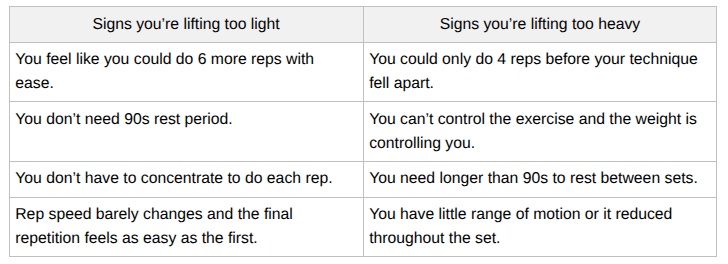
Another thing to help you is to track the weights that you use so you have a benchmark that you can adapt and adjust to depending on how you feel and your endurance training, eg. a 7/10 RPE with a 100km bike ride in the legs usually feels different to a 7/10 RPE after a rest day! We use subjective measures like RPE/RIR for this very reason as we want strength training to support your endurance performance.
Don’t forget that the target RPE/RIR, sets, repetitions and intensity of the load will depend on the strength quality you’re trying to develop. A maximal-strength phase will look very different from an anatomical-adaptation phase, and this will be reflected in the weight you lift.
Remember strength training should be periodised just like your running and cycling, some months will call for lighter weights, some will call for heavier weights. Regardless of where you are in your season you want to be lifting heavy enough to get the adaption you’re after and the 3 ways we’ve covered here will help you to do so.
If you want help answering the question: “Am I lifting heavy enough?” Please head over to my free coaching community for support and advice.
Happy running and riding!
Emma x
Join the Strava club!
3 FREE WAYS TO ELEVATE YOUR RUNNING & CYCLING: |
|


Comments