

Everyone’s talking about lifting heavy... but here’s what they’re missing.
- Emma O'Toole

- Dec 14, 2025
- 5 min read
Heavy lifting is one of the best tools for performance, but only when done on a solid foundation.
In this article, Emma O’Toole explains why technique comes before load, how poor movement patterns limit adaptation, and what structured progression really looks like for runners and cyclists.
Strength training for runners and cyclists over 30 is a game-changer for performance, resilience, and long-term health.
If you want the full breakdown, check out my Strength Training Over 30 Guides:
TRAINING BREAKDOWN
"Heavy lifting does not fix poor technique, it exposes it."
By Emma O'Toole
Hello!
You wouldn’t try to run a 10K PB before you can comfortably run 10K.
You wouldn’t try to push your average speed higher on your 50km loop before you can actually finish the 50km.
To us runners and cyclists, this makes perfect sense.
However the moment we consider strength training, this logic goes out the window.
Suddenly everyone wants to lift heavy, because it’s the current buzzword and having a moment:
Great for endurance performance.
Great for power.
Great for bone density.
Great for perimenopausal women.
Great for aging athletes.
All of these are accurate and huge benefits of lifting heavy that go far beyond our running and cycling.
However, what the headlines and top-performing reels out there are missing is that lifting heavy only works if the foundation underneath it is solid.
The same way we don’t chase speed before we’ve built the miles, we shouldn’t chase load before we’ve built the movement, and in today’s newsletter I’m going to explain why.
Whenever I start coaching a runner and cyclist new to strength training, 9 times out of 10 their weakest movement pattern is the hinge. Exercises like, deadlifts, RDL’s, single leg deadlifts etc, is where it most shows up.
This isn’t because the runner/cyclist isn’t strong enough, it’s because they haven’t solidified the movement pattern.
It often looks like:
Rounding through the spine,
Tension lost halfway down,
The weight drifting forwards,
Knees bent, it looking more like a squat than a hinge,
And force going everywhere except the glutes and hamstrings.
Here’s an example of a couple of the points above:
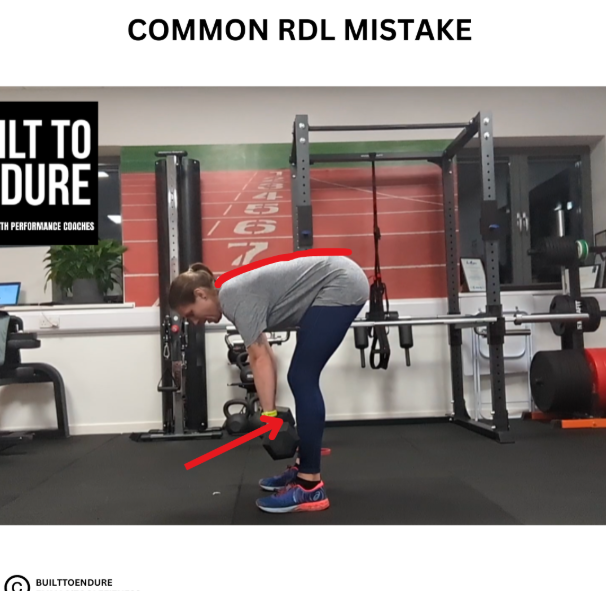
If you add heavy load to that pattern, you don’t get stronger, you get better at doing the wrong thing under a higher amount of stress, and that's why you hear so many people say “I hurt my back deadlifting.”
It’s the strength equivalent of trying to run a faster 10km before being able to even run 10km.
The timing is all wrong.
Let’s compare the above photo side by side with a sound hinge movement pattern in the Romanian Deadlift Exercise.

The image on the left is how most runners and cyclists hinge when they don’t have a video to compare against, or if they don’t know otherwise. Without that reference point, it’s easy to build bad habits, and even easier to reinforce them once you start lifting heavier.
Why lighter loads matter more than runners and cyclists realise
There’s this misconception that lighter loads equal beginner work, they don’t. Every year I go back to bodyweight and band work and I’ve been strength training consistently for years on end.
Lighter loads:
Refine technique,
Improve coordination,
Build positional strength,
Make you better at the exercise.
Strengthen the tissues you need for heavier lifting.
And give you confidence for heavier lifting.
They build your foundation, like running and riding in zone 2 does for your endurance.
Heavy lifting does not fix poor technique, it exposes it.
If you can’t deadlift well with 15kg, you won’t magically deadlift well with 60kg.
Just like if you can’t run 6km comfortably, running 10km won’t suddenly sort it out.
These things don’t auto-correct with effort and intensity, they improve with structured progression through a dedicated programme.
This is the exact reason why my ready made programmes, BUILT TO RUN, BUILT TO RIDE, and the 16-week Off-Season BASE programme, all take you through this structured progression:
Technique → Stability and Endurance → Moderate load → Heavier load → Power
We build the foundation so when you do lift heavier later in the block, it actually delivers the adaptation it’s supposed to: you lift heavy when your movement can support it, not before and it always takes into consideration your running and cycling training by working subjectively.
And we do this without compromising your running or cycling by adjusting loads based on how you subjectively feel each week.
Because what feels heavy to you one day can feel light the next, especially for those of us over 30 balancing:
Kids,
Work,
Life admin,
Early starts,
Late nights,
And fluctuating recovery.
Just like 10-minute miles can feel easy one week, and after a 20-mile long run the day before… not so much.
The real skill is being able to adjust based on how your body feels and what the rest of your training week looks like.
And this is when heavy lifting becomes:
Safer,
More effective,
More powerful,
And a hell of a lot more transferable to your running and cycling.
Heavy lifting is brilliant. It’s effective, powerful and hugely beneficial for runners and cyclists, especially over 30 who want to stay strong and durable for years to come.
However it only works when the foundation underneath it is solid.
Like I say to my coached athletes, the weights aren’t going anywhere, but trying to undo bad technique is hard and takes time!
If you want to start building this foundation properly, I’ve created two completely free strength programmes, one for runners and one for cyclists, each with beginner and experienced options so you can choose what matches you best.
New to Strength Training (Runner)
New to Strength Training (Cyclist)
Experienced with strength training (Runner)
Experienced with strength training (Cyclist)
Get in touch and let me know the one that’s the best fit for you and I’ll send it over to you.
If you want me to check over your hinge movement pattern, join my free community for runners and cyclists over 30, and drop me a message- with a few adjustments you’ll get so much more out of the exercise and your time.
Have a great day!
Emma x
Join the Strava club!
3 FREE WAYS TO ELEVATE YOUR RUNNING & CYCLING: |
|


Comments