

Training Volume for Runners and Cyclists: Do You Need More to Get Faster?

Higher training volumes are generally associated with better endurance performance, but more is not always better. The right running or cycling volume depends on your current training, experience, goal event, recovery, available time and ability to tolerate the workload consistently. This article explains how training volume affects endurance performance, how to decide whether you need more, and how to increase your weekly volume without compromising your key sessions or recovery.
Strength training for runners and cyclists over 30 is a game-changer for performance, resilience, and long-term health.
If you want the full breakdown, check out my Strength Training Over 30 Guides:
TRAINING BREAKDOWN
"Volume, ultimately, is only as useful as your ability to consistently tolerate and recover from it."
By Emma O'Toole
Hi there,
In last week's blog post we started looking at how you can run and ride faster after it came out on top in a poll inside my free coaching community.
We began with actually running and riding faster, your key sessions, how hard you need to work and making sure you’re getting the desired stimulus from those sessions. If you missed that, click here to read.
This week I want to talk about volume, aka, how much running or riding are you doing each week?
It’s easy to focus on the sessions that look more exciting on paper… the intervals, threshold work, the workouts that usually look quite impressive when they upload to Strava and so on. However, those sessions only make up part of your training!
A lot of your endurance training should feel relatively comfortable because that allows you to accumulate more volume, develop your aerobic fitness and manage fatigue so you can keep training consistently. You’ve likely heard the terms “easy run” or “easy ride” - these are the types of sessions that I’m referring to here.
When we look at endurance performance, higher training volumes are generally associated with better performance. There’s an interesting study involving almost 1,000 recreational half-marathon and marathon runners.
The researchers looked at weekly training volume, longest endurance run and race performance. Higher weekly training volumes were associated with faster finish times in both the half-marathon and marathon runners.
Now, worth pointing out that this was an observational study, so we can’t say the higher volume caused the faster performances. There are lots of reasons why faster and more experienced runners may also be able to run more. However, we see a similar pattern in a much larger recent study looking at the 16 weeks of training leading into more than 150,000 marathons. The fastest runners accumulated more than three times the training volume of the slower runners, with much of that additional volume coming from lower-intensity running.
So volume clearly is an important piece of the endurance performance jigsaw, but how much volume you can and should do also depends on your sport.
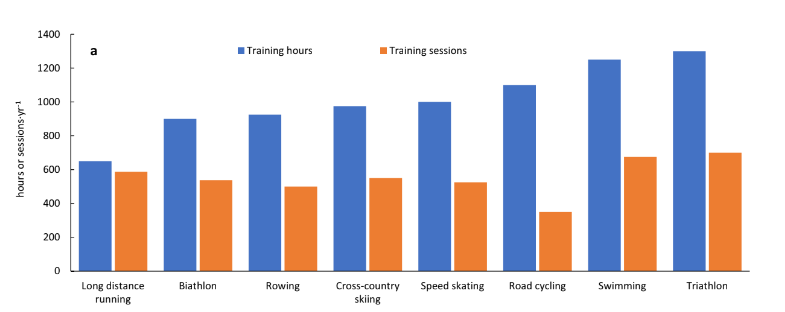
Looking at the table below, you can see that cycling usually allows for more training volume than running, with triathlon higher again because that volume is spread across three disciplines. One of the main reasons is that cycling has a much lower impact and mechanical loading than running, so athletes can often accumulate more time without the same orthopaedic stress on the body.
It’s also why cycling can be a really useful cross-training option for runners who struggle to tolerate higher running volumes but still want to build more aerobic work into the week.
Fundamentally, running and cycling are skills and to get better at them, we need to practise them.
How much volume do you need?
There isn’t a magic weekly mileage for runners or number of hours for cyclists that holds the key to better performance. What’s important is your current training, training and injury history, goal event, available training time, recovery, how you’re responding to the training you’re already doing and if you’re maximising your current training time.
Too much, too soon with too little is a huge risk of adding more volume. What I mean here is that you increase your training by too much in a short time-frame, but you’re doing it with the same baseline strength and capacity you had before those additional training demands were added. Eg. you’re doing no strength training to support your running and riding, or your training has increased but you’re still fuelling your body as you were before.
Volume, ultimately, is only as useful as your ability to consistently tolerate and recover from it. This is why we want to build it steadily and make sure your strength training, fuelling and recovery develop alongside the demands of your running or riding. If you’re constantly doing more training than you can tolerate and recover from, excessive fatigue and niggles can start interrupting your training and when your training keeps getting interrupted, it becomes very difficult to stay consistent… and consistency is king!
Take 2x runners over the last 4 weeks:
Runner A runs:
Week 1- 30 miles
Week 2- 32 miles
Week 3- 32 miles
Week 4- 27 miles
Runner B runs:
Week 1- 15 miles
Week 2- 31 miles
Week 3- 8 miles
Week 4- 35 miles
That second example is something I see quite often with busy runners and cyclists. A good week comes along and they get most of their planned training done, then the following week life gets busy, they have no backup plan and their training volume looks very up and down.
I'd much rather build volume that you can repeat and recover from. If you’ve consistently tolerated your current training, you’re recovering well and your goal would benefit from more volume, then we can look at gradually building it.
If you’re already struggling to recover, regularly having bigger weeks and then the following week missing sessions or carrying niggles, adding more training isn’t the first thing I’d change in your training.
How do we add volume?
The best thing you can do is to not jump. Start where you are and make gradual changes, absorb those changes and then look to potentially increase again. For example, if you’re currently training 4 hours a week over 3 days, don’t suddenly go to 8 hours a week over 6 days. Try 5 hours a week over 4 days and see how you feel both inside and outside of training and how your performance responds.
And remember what we talked about last week: Volume and your key sessions have to work together.
If adding another run or another couple of hours on the bike means you arrive at your key workout too fatigued to get the desired stimulus from it, we need to look at what that extra volume is actually adding.
This is where your training week needs to work as a whole. Your “easier” training helps you accumulate volume and develop your aerobic fitness, while your key sessions allow us to target the specific qualities you need for your goal.
Then you need enough recovery to absorb all of it and go again, week after week, month after month, and this is where deload and consolidation weeks help massively.
The best piece of advice I can give you is to look at your previous training over the last 6-8 weeks and see what your weekly volume looks like.
Then ask yourself:
Am I recovering well enough to get what I need from my key sessions and my training in general?
Does my current volume match what I’m training towards from a goal and performance perspective?
Do I have the capacity to add more volume?
Everyone’s answers to that will be different and remember your training volume shouldn’t be fixed. The volume you're doing 6 weeks out from your 600k audax should look different to what you’re doing in your off-season.
Following your answers to the above questions, you might need to be more consistent with your training and the volume you’re already planning.
You might not need to increase your volume, or you might be unable to because of work/family/life commitments. Instead, you might need to better use the X amount of hours that you do have to train each week.
Or, you might find that gradually increasing your volume is one of the key things that could help you to run or ride faster.
If you want some help looking at your own training volume, come and join us inside my free coaching community for runners and cyclists over 30, or get in touch here and tell us what you're training for and what your average training week currently looks like.
Happy running and riding!
Emma x
Join the Strava club!
3 FREE WAYS TO ELEVATE YOUR RUNNING & CYCLING: |
|
References:
Sandbakk Ø, Tønnessen E, Sandbakk SB, Losnegard T, Seiler S, Haugen T. Best-Practice Training Characteristics Within Olympic Endurance Sports as Described by Norwegian World-Class Coaches. Sports Med Open. 2025 Apr 25;11(1):45. doi: 10.1186/s40798-025-00848-3. PMID: 40278987; PMCID: PMC12031707.


Comments